Photo Restoration in the Future
When you do the photograph restoration near me, it is likely that you will expect a professional to put his magic on your old and dark photos. It can be a photo of your wedding day, a family getaway or a historic event, but there is time, work and a steady hand in the traditional photo restoration. However, one more new entrant exists: AI-driven photo restoration. There is an increasing number of individuals resorting to AI as a quicker, more efficient, and cheaper method of recovering their memories. We shall discuss the reason why AI restoration of old photos is the game-changer in photo restoration in the world.
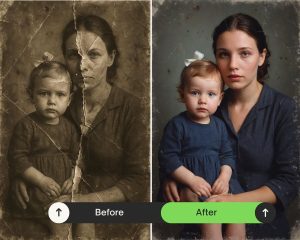
Speed: Quick Results, No Delays
We have all been that way, handing over an important photo to a local restoration shop and anxiously waiting weeks to have it back. It is heart-thumping, especially when the picture is sentimental. And we also shall not forget about that back-and-forth process when there is uncertainty whether you will see the same results as you were having in your vision. The process of doing the restoration traditionally may seem like a lifetime, and to many people this wait may prove to be worse than the restoration process.
The game with AI is totally different. All you do is to post your picture, and within minutes it is restored. There were no waiting days, no driving back to retrieve it, and no guessing whether you are going to receive the results you are hoping to receive. AI restoration is difficult to match in speed. To a person who appreciates the speed with which he or she can retrieve memories that have been revived, this immediate process is a big bonus.
Economical Restoration: More with Less
You have had an experience with a photograph restoration close to me, and you know that the cost of the services can soar. Professionals will charge per hour, and that will run into lots of money, and this is even if you have a pile of photos that you want restored. In the case of photo restoration using AI, it is a lot more predictable. The majority of the services are of a flat fee per image, which means no unexpected bill or unseen expenses.
The affordability factor does not necessarily end at cost. The fact that AI can work with many images within a limited period of time ensures that the cost per photo is much less than the cost of manual restoration. Besides, AI does not demand the overhead costs that conventional services demand—no physical store, no costly hardware. Consequently, you will receive the professional restoration at a lower cost.
Precision and Accuracy: The Magic of Algorithms
The question you may be asking yourself is, is it truly possible to get the details right with AI? Is it as accurate as a professional restorer can be? It’s a valid question. Human restoration is rooted in a profound concern for textures, colors and history, after all. However, AI is not limited to making corrective decisions.
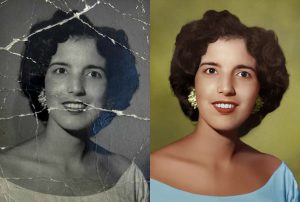
With AI, restoration is achieved through analysis of millions of photos and patterns, and with the help of this large database, your image is fixed. It is able to identify flaws, correct the faded colors, and even recreate the lost items, according to well-informed assumptions. When a human restorer is able to make judgments and use intuition, AI is able to use data to develop a decision, creating a high degree of uniformity among several images. It is possible that even with a highly damaged or faded photo, it can be restored with amazing precision.
Managing High-Volume Projects: AI Does Not Get Tired
In case you want to recreate a complete album the speed and efficiency of AI make it the optimal option. The conventional photo restoration service providers tend to hit a bottleneck as soon as a large number of photos are involved. One technician is only able to work on one image, and this makes it difficult to handle several projects simultaneously.
AI doesn’t have this problem. It is able to manipulate hundreds or even thousands of images in a fraction of the time that it would take a human being. Its scaling capability is what makes it suitable for anyone that has a big collection of old photos, be it a family album, an historical image collection, or a company that needs to digitize and restore a large number of photos.
None of the Guesswork Left: AI Seals the Gaps
A drawback of the traditional method of photo restoration is that in certain cases missing parts are involved—huge portions of a photograph can be ripped, faded or lost altogether. The human restorer has to make guesses on how they are going to fill in those gaps, and this may be determined by their vision of the image. Although they can do this very well, it is not always utopian.
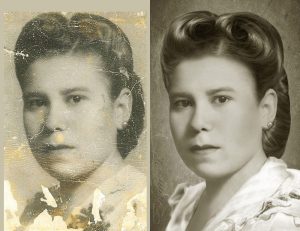
AI, however, doesn’t guess. It applies algorithms to estimate and kind of recreate lost information at a high level of precision. Be it the reconstruction of ripped edges or the creation of missing faces, AI can make an informed guess when shown millions of similar images that it has gathered. The outcome is that the restoration will be much smoother, with the missing parts being as organic as the original.
The Bottom Line: AI is the New Standard
Still, why are so many people preferring AI to restore old photos to the traditional services? It is all about speed, cheapness, and convenience. AI is a nice and cheap service to revive the great memories without emptying the wallet and spending weeks. The accuracy and speed with which AI has restored photos have made it a potent tool for individuals who want to restore their old and faded photos and bring them to life in a fast and efficient way.
Although human skills are still valuable in some scenarios, AI has demonstrated that it can complete most (by far) of photo restoration tasks with impressive outcomes. AI is the future of photo restoration, and it runs on AI.