The Future of Restoring Photos Is Here
When you type “picture restoration services“ in a search engine, what comes to mind is a professional sitting up with the magnifying glass attempting to make a photo that is no longer youthful on the page. It is tedious and costly, and in most cases, it also consumes a lot of back and forth to make things correct. However, all that is changing with the emergence of AI. Old photos are one of the technologies that have revolutionized the way we treat valuable memories, and they are rapidly gaining popularity as the first solution for any person who wants to bring back his/her lost memories.
The Quickening of AI: A Game Changer of Restoration
You know the drill: when it comes to the restoration of an old photo by hand, it is a time-consuming task. A restorer can devote a few hours, or even days, to a single photo, making corrections and attempting to restore its original attractiveness. The outcome may be breathtaking, but the waiting time may be interminable.
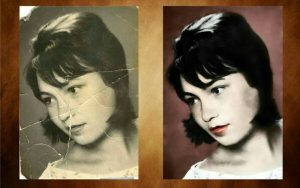
Here’s where AI shines. When you send a photo to be restored by AI, it happens in a timely manner—usually several minutes. AI does not have to be shown every minute detail separately. Rather, it involves complicated algorithms that scan the image and automatically rearrange hues, add areas that have been lost, and correct distortions. Tasks that were once done in days can be done in seconds. When you own an entire album of aged photos, then AI can get busy on a bunch of pictures at the same time, which makes it a very time-saving choice.
Precision Out of This World
However, though speed is a massive advantage, the accuracy of AI is what makes it different. Human restorers are very good, and yet, to some extent, there is a type of guesswork. They operate on the things that are seen in the picture and make their best efforts to restore the things that are missing. In some cases, it’s a miracle, but in others, you could find that there are some slight differences in color or form.
AI doesn’t guess. It relies on the data of thousands of other similar photos to give what a restored photo should appear like. The result? There are far greater odds of redressing a photo to its former glory, even when the image has suffered blatant injury or age. The lighting, texture, and patterns can be examined with amazing accuracy using AI. It does not merely repair the broken ones—it anticipates what is lacking and makes up the missing by that.
More Inexpensive Than You Think
Conventional photo restoration may be of huge cost. Hourly rates are implemented by the professionals, and when there are several photos that require work, it may be very expensive. AI, in turn, is based on a simpler pricing model. You usually pay a single fee per picture, so it’s much cheaper, particularly when you have a large amount of photos to restore.
Besides saving money, the restoration services provided by AI do not usually need a two-way interaction that a manual one does. After you have put your photo online, you are presented with the end result within a fraction of a second; no more waiting until you make revisions or modifications. It is one of the reasons why AI is gaining popularity in the industry due to its fast, efficient, and cost-effective service.
Human vs. AI: The Highest Precision of Both Reality
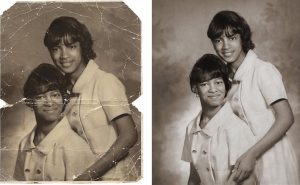
It is possible to assume that the precision and speed of AI would make human restorers redundant. However, the real state of affairs is that AI and human experts collaborate to produce the most favorable outcomes. The bulk of the work is done by AI that is able to process images and reinstate the big-picture elements in a matter of seconds. However, when it comes to the finer, more specific details, such as changing the emotional context or coming to a conclusion regarding the historical context of the image, a human touch will still be required.
As an example, a photo that is missing a significant part of the background will probably have this filled by AI with a general approximation as per what it has learned about similar photos. Yet, a qualified restorer is able to intervene and make artistic choices that would make the restoration appear like the original scene. By utilizing the accuracy of AI and the skill of a professional, you are guaranteed to have the best of both worlds, i.e., speed, cost-effectiveness, and detail-focused.
AI Brings Color Back to Life
The possibility to restore old black-and-white photos in color is one of the most amazing things about AI restoration. Colored black and white images can be colored in a realistic way by AI, regardless of whether it is an old family portrait, a faded vacation snapshot, or a historical image. AI does not simply give a picture a random coloring. It examines the images and forecasts the most correct colors of things such as skin tones, clothing, and backgrounds.
The work of colorizing images is usually superior to what would be achieved through a manually restored image, as AI can use millions of images to learn how things are supposed to appear in color. What used to appear to be an old, far-away memory can now be brought to life with bright and clear colors, which are true-to-life recollections of the original picture. The result? An image that looks newly taken, although it may be decades old.
Why AI Is the Future of Picture Restoration
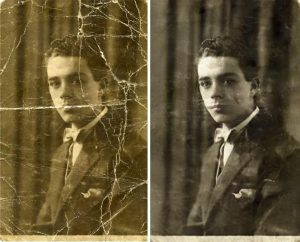
The picture that comes to your mind when you hear “picture restoration” is a long, costly, slow, tedious process. But AI photo restoration has put all that on its head. The pace of AI, its accuracy, and affordability render it a precious asset to both professionals and personal individuals. You can use AI to relive history—it has been faster, cheaper, and more efficient than ever before, whether you are restoring a family heirloom or a historical moment.
Photo restoration has a very promising future, and with artificial intelligence in charge, we may not know how many more memories we can recall from the past.